When most people hear the word “perch,” they picture a bird. But birds aren’t the only ones looking for a good place to sit. Dragonflies use perches too, and many species depend on them.
I learned this almost by accident. When I first started placing perches for birds, I noticed right away how many different dragonflies were using those same perches. What I’d put out for birds was serving a whole second group of wildlife I hadn’t even been thinking about.
A recent example: a Blue Dasher kept trying to land on a tall blade of grass beside my chair. Every time it landed, the blade bent over and it had to fly off and try again. I pushed a slender three-foot piece of bamboo into the ground in that same spot. Within minutes the dragonfly was on it, and it stayed there for hours.
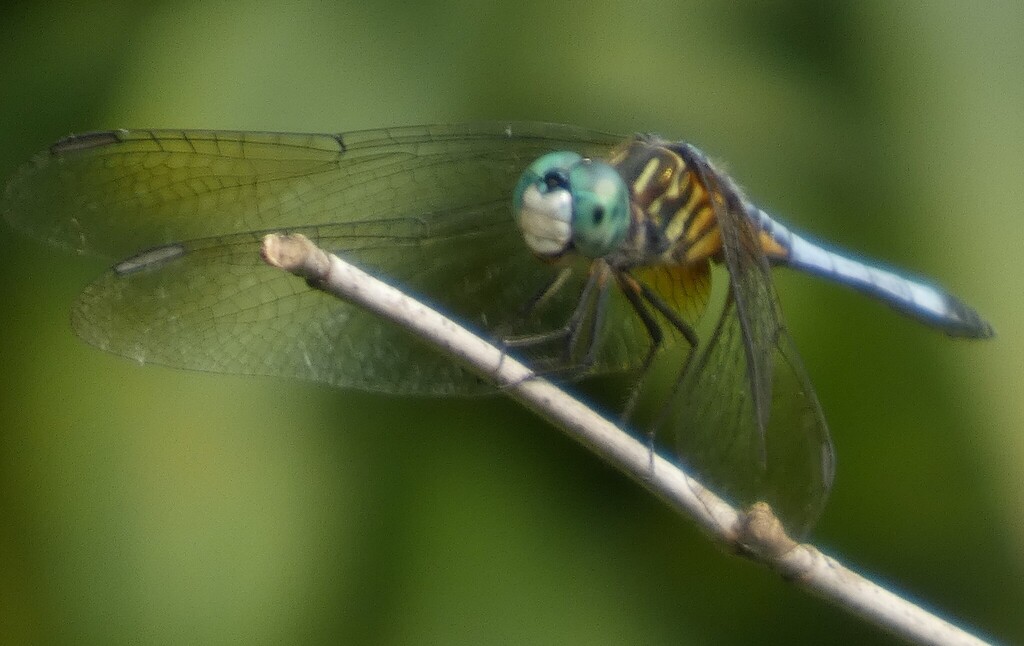
Fliers and Perchers
Some dragonflies cruise nearly all day and are rarely seen resting, except early in the morning when they’re still covered in dew. Others hunt almost entirely from a perch. They sit and watch until they spot prey, launch off, catch it, and return to the same perch to eat it.
These aren’t hard-and-fast categories. Saddlebags, often thought of as constant fliers, perch frequently in my experience. They tend to do it high, usually 10 to 50 feet up, on a small dead twig at the top of a tree.
Many Kinds of Perches
- Natural sticks and stems: old cattail stalks stripped to the central stem, twigs, brush, and branches
- Treetops: exposed dead twigs high in a tree
- Bare ground and logs: the Common Whitetail is a familiar example
- Alligators and turtles: smaller species that can’t compete for the best sticks may settle on an alligator’s head or a turtle’s shell. I’ve photographed Eastern Amberwings on alligator heads several times, and there the larger dragonflies leave them alone.
- Floating vegetation: damselflies often rest right on duckweed and other floating plants
- Emergent leaves: some dragonflies perch on aquatic plant leaves sticking up above the water
When small species resort to alligators and turtles, it tells us competition for good perches is real.
[PHOTO: Eastern Amberwing on an alligator head, if available]
What a Few Perches Can Do
My own results come from one small spot at home. It’s at least 60 feet from any water and hundreds of yards from the nearest pond. In roughly 5,000 to 6,000 square feet, including a native wildflower bed with more than a dozen placed perches, I’ve recorded:
- 32 species of dragonflies and damselflies overall
- 16 species in the new wildflower bed since May
- 7 species on a single tall perch since late May, including Halloween Pennant, Roseate Skimmer, and Red and Carolina Saddlebags
In the wildflower bed, every dragonfly species except Eastern Pondhawk and Eastern Amberwing has been photographed on a perch every time, with a single Blue Dasher exception. The damselflies rest on vegetation instead.
For perspective, iNaturalist shows 74 dragonfly and damselfly species recorded in all of Duval County. The 32 from this one small spot are more than any other single observer has recorded across the whole county.
To be fair, these totals reflect how much time I spend looking, and perched dragonflies are easier to spot and photograph than ones hidden in the leaves. Still, the pattern is hard to ignore.
[PHOTO COLLAGE: species on slender stems]
Try It Yourself
You don’t need a pond to do this, though a pond helps. A slender stick or piece of bamboo pushed into the ground in a sunny, open spot is often all it takes. Something with a thin tip, or a small side branch sticking out horizontally, works especially well.
At a pond, place the stem a foot or two out into the water, rising up and arching over or with a small side branch. Many maintained ponds have shorelines kept so clean that no natural perches remain, and a few sticks can make up for what’s been stripped away. Keeping them a little offshore also keeps them out of the way of anyone mowing or trimming the bank. If people fish there, skip the spots where they cast.
Then sit back and watch. A well-placed perch in the right spot will often have a dragonfly on it within minutes.


Leave a Reply