
This isn’t just an article about a plant. It’s an article about a way of growing one — because grown the ordinary way, Blue Mistflower (Conoclinium coelestinum) is a decent nectar source. Grown deliberately, the way I grow it, it becomes the single best plant I’ve found for fueling fall migrating Monarchs.
The real key is how you grow it and manage it. Give each plant extra space and cut it back a few times, and it will turn into something more like a bush, covered with dozens of bloom stalks instead of just a few.
These are the primary reasons I’d point anyone toward this plant. The first is its reputation: search Blue Mistflower online and you’ll run into words like aggressive, spreads profusely, and can take over a bed. Most gardeners treat that as a warning. I treat it as the whole point — the very thing that earned it a bad reputation is one of two things that make it a rock star for fall Monarchs. A plant that wants to spread that fast and fill in that thick is exactly what you want when the goal is a dense mass of bloom, not a few scattered flowers.
The second reason is timing. Blue Mistflower hits peak bloom from mid-September through mid-October and beyond — which lines up almost exactly with the fall Monarch migration window across most of its range. It’s not an early or a late bloomer relative to migration; it’s dead center. And that timing matters more than most advice on helping Monarchs lets on.
Ask most people how to help Monarch butterflies, and you’ll hear one word: milkweed. It’s true — and it’s also only half the story.
Milkweed matters for spring and summer, when Monarchs are laying eggs and their caterpillars need something to eat. But by fall, that part of the job is done, and often so is milkweed itself — most milkweed species have finished blooming by the time fall migration gets underway. The Monarchs migrating south toward Mexico aren’t laying eggs anymore either; they’re flying thousands of miles on nothing but the nectar they can find along the way. What they need is fuel: flowers, in bloom, in quantity, right when they’re passing through.
Managed, Not Just Grown
Left alone in the wild, Blue Mistflower tends to produce thin, spindly stalks with just a few blooms, crowded out by competition from other plants. That’s the version most people picture when they hear the name — and it’s not the plant this article is actually about.
What I grow is a different plant entirely — not a different species, but the same plant, given room and intentional management: isolated from competition, and cut back at the right points in the season to force it into dense, bushy growth with far more flowering stems than it would ever produce on its own. Handled this way, a single plant turns into what looks more like a small flowering shrub. The cut stems themselves can be rooted as cuttings, producing new plants that will usually bloom that same year — and cutting the parent plant back also stimulates it to produce more shoots, which become still more new plants the following spring. The bed keeps expanding on its own.
One more thing worth saying plainly: large masses of bloom are what draw butterflies and migrating Monarchs in real numbers — not a handful of scattered flowers. That’s exactly why the growing method described above matters so much. A few unmanaged plants might bring a visitor or two; it’s the dense, heavily-bloomed planting that pulls in dozens or hundreds of Monarchs at once. Don’t grow a few plants and expect hundreds of Monarchs to show up — that’s not how this works. The density is the draw.
Why It Wins, in Four Parts
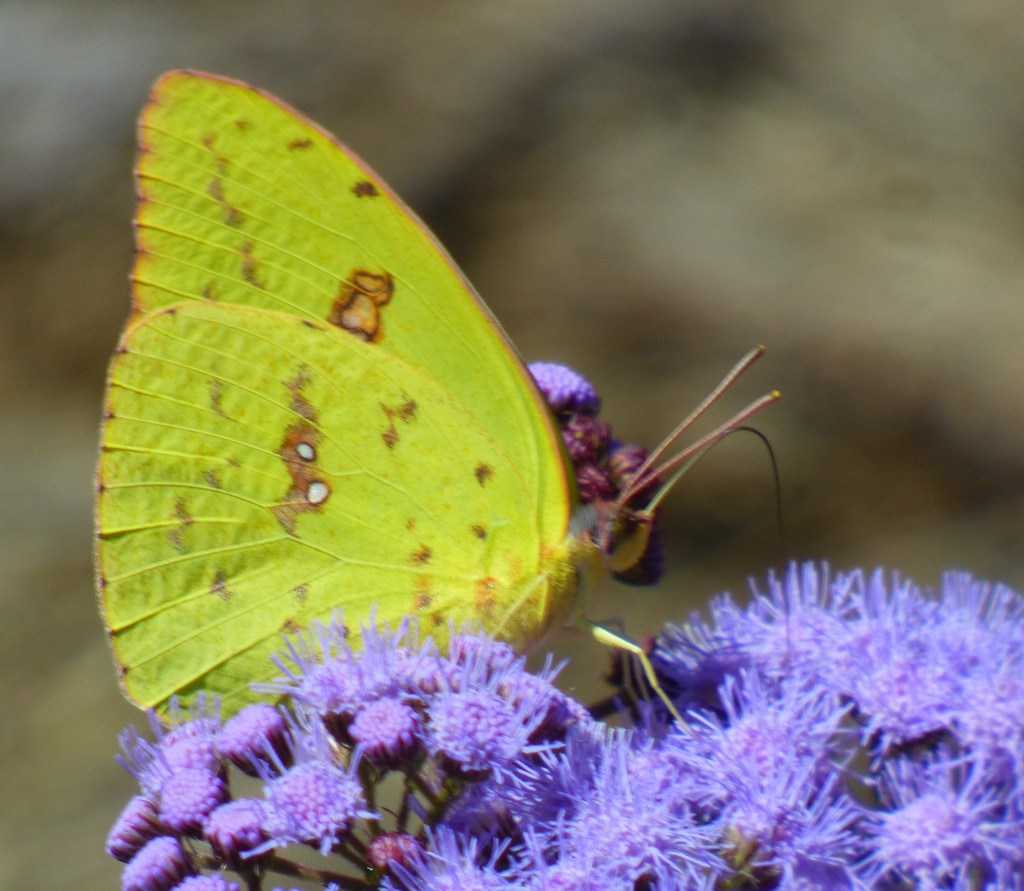
Proven magnet. Independently, not just in my own observations, Blue Mistflower is repeatedly described as a genuine butterfly magnet — drawing Monarchs, Swallowtails, and many other species. My own experience goes further than that: on roughly 750 square feet planted densely with around 150 plants, in Abbeville County, South Carolina, I documented 100 or more Monarchs at a time, for about ten days straight, during fall migration — the photo above, showing 26 individual Monarchs in a single frame, was taken during that same stretch.
Perfect timing. Blue Mistflower’s bloom peaks from mid-September through mid-October and beyond — which lines up almost exactly with the fall Monarch migration window across most of its range. It’s not an early or a late bloomer relative to migration; it’s dead center.
Manageable into denser bloom. As described above, this isn’t a plant you just put in the ground and hope for the best. A little intentional management turns it from a scattered nectar source into a concentrated one — and concentration is what actually pulls in large numbers at once, rather than a few visitors trickling through.
Exceptionally easy to propagate. New shoots come readily in spring, and cuttings root easily through the season. A small starting patch can multiply into a much larger planting that same year, and a very large planting the next year and beyond — without needing to buy more plants.
An Independent Reaction
I’ve shared this work directly with people who’d know. Dr. John Snyder, a former Furman University entomology professor who founded the university’s arthropod collection and the South Carolina moth database, saw what I’d built in Abbeville and told me he’d never seen anything like it in South Carolina before. I can’t independently prove that statement — it’s his impression, not a study — but it came from someone with a genuine, professional basis for comparison.
And here’s the thing: when people talk about the states that matter most for fall Monarch migration, South Carolina rarely comes up. The well-known corridor runs through places like Texas and the Midwest — much of the South, South Carolina included, gets treated as little more than flyover country in that conversation. If I was able to draw that many Monarchs to one bed in a state nobody associates with the migration, it raises an obvious question: what would happen if this same approach were grown at scale somewhere that actually sits on the main corridor?
Try It Yourself
You don’t need 750 square feet to see the effect start to build (though the larger the bed and the more blooms it produces, the more Monarchs you’re bound to attract). Start with a few plants, give them room, cut them back once or twice through the season to encourage bushier growth, and let them establish. By the time fall migration comes through, you may be surprised who stops by.




Leave a comment