Most gardeners plant to attract pollinators. I found one that was already doing the attracting — before I even knew what it was.
In 2024, as I began forming a new pollinator habitat, small seedlings started coming up on their own. When they bloomed, I posted them to iNaturalist and got my answer: painted spurge, Euphorbia heterophylla, a native plant I’d never seen or even heard of before. It’s easy to overlook, and easy to confuse with its showier lookalike, paintedleaf (Euphorbia cyathophora), which carries the bright red-and-green bracts most people picture when they hear “painted.” Painted spurge has none of that. Its flowers are pale green, sometimes with a faint pink blush, with no showy petals at all — plain enough that you could stand right next to a blooming plant and not realize you were looking at a flower.
It’s also an annual, living fast and relying entirely on reseeding to return each year. Its life cycle can run as short as six to eight weeks from germination to seed, letting it push through several generations in a single season. When the seed capsules ripen, they don’t rely on wind or hitchhiking burrs — they split open explosively, flinging seeds a short distance from the parent plant. Between the speed and the volume — a single plant can produce thousands of seeds — it’s an aggressive reseeder. But in my own experience, that doesn’t translate into an aggressive plant. In three years of looking, I’ve only found it growing wild in two or three places, and the one sizable patch I found was in a regularly mowed field — exactly the kind of open, low-competition ground it seems to need. Give it other plants to compete with and it struggles. It’s also shallow-rooted and comes up with the lightest tug, so if it ever shows up somewhere you don’t want it, removing it takes seconds. It’s a plant that reseeds readily but doesn’t take over — it just fills empty ground while it’s empty.
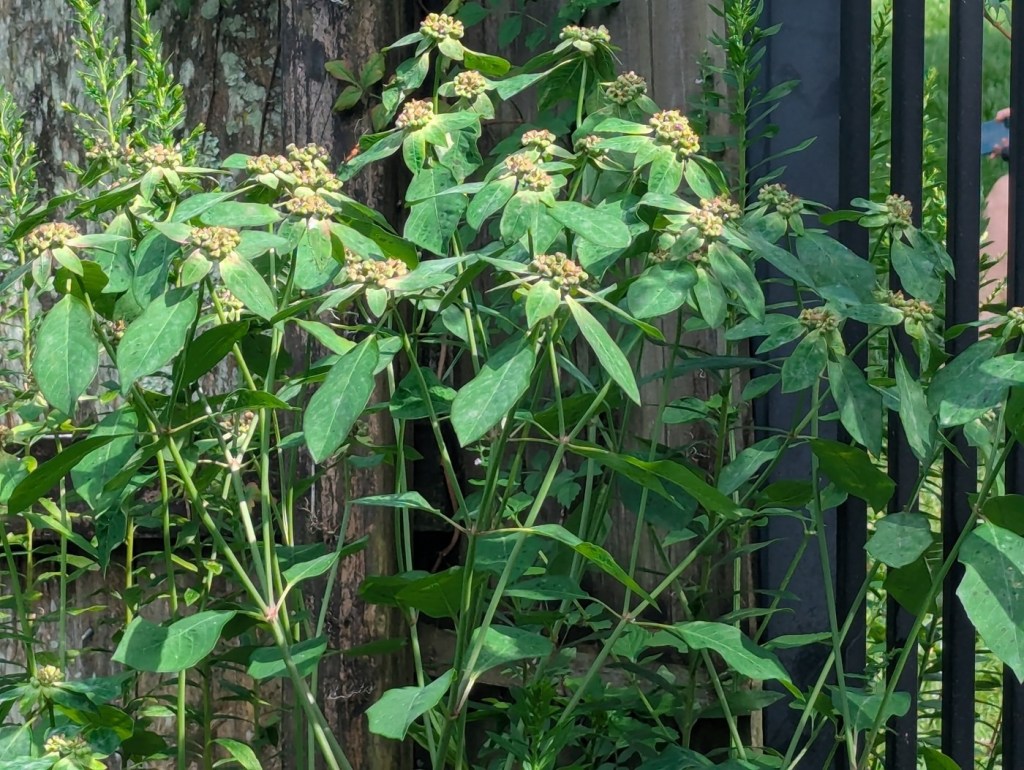
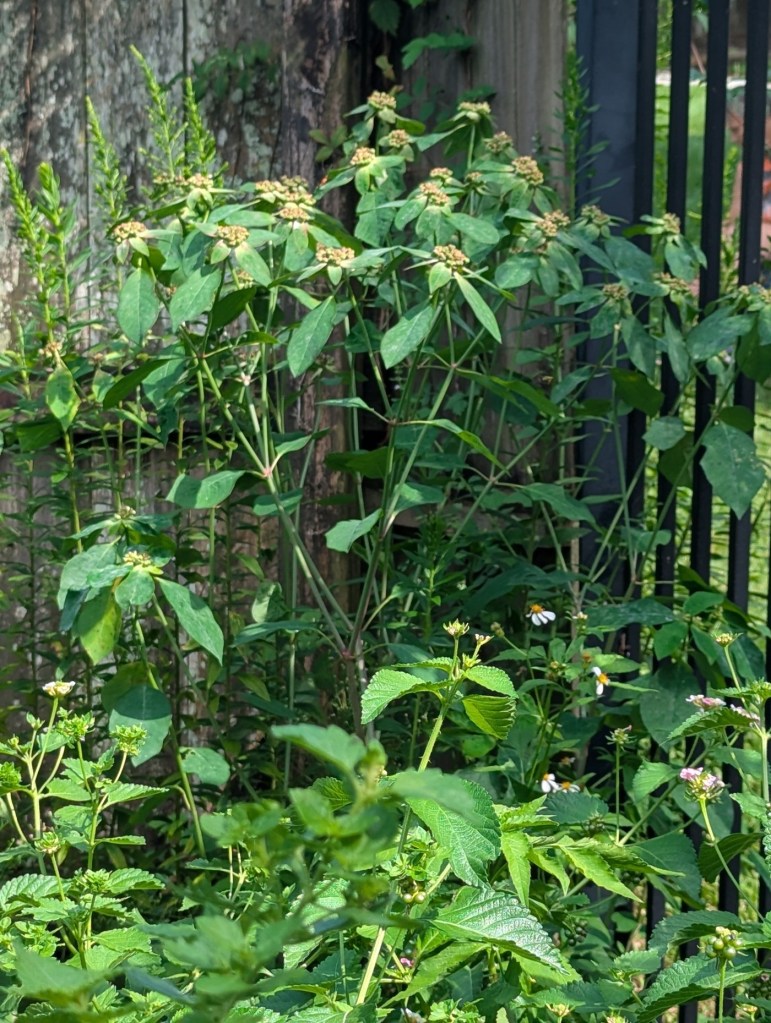
Painted spurge growing among lantana and Spanish needle along a fence line — its upright stems and flat-topped flower clusters stand out above the surrounding growth.
 Ken Carman — Conservation & Nature
Leave a comment